Showing posts with label Lab Theater. Show all posts

Tuesday, April 18, 2017

Five Weeks - Pangea World Theater

Going into Pangea World Theater's new play at the Lab Theater, I knew next to nothing about Partition, the term used for the post-WWII division of formerly colonial India into the countries of India and Pakistan.

Five Weeks: A Play About Divided Hearts, written by Meena Natarajan, is a heartrending, personal look at Partition and the many human costs that ensued.

A bit about Partition: In 1947, the British government assigned a lawyer to draw the new border. Sir Cyril Radcliffe had no experience in India, or with drawing borders, and within five weeks, had drawn a border that allowed little consideration of demographics. Despite a stated intention to keep most Sikhs and Hindus in India and most Muslims in Pakistan, the reality was much more complicated.

Photo by Bruce Silcox.
After thousands of years of coexistence, Partition divided up shared communities, neighborhoods, and social circles. As families migrated from one country to the other, about a million refugees were killed, millions more were displaced, and an estimated 75,000 women and children were raped and abducted, most of whom were never recovered.

Natarajan's script weaves together stories of families and friends divided by Partition, bringing the massive carnage to a very personal level. A child is separated from her parents during their flight, a college-educated woman naively tries to help refugees, and a family finds its home no longer safe in just a few of the stories woven through the evening.  

Projected captions indicate place and time, and also provide translation of some of the dialogue, which includes Punjabi, Bengali, Hindi, and Urdu as well as English, sometimes in the same conversation. Live musical accompaniment is performed by singer Pooja Goswami Pavan, tabla player and vocalist A. Pavan, and keyboard player Vijay Rmanathan.

Photo by Bruce Silcox.
Local actors of South Asian descent make up the acting ensemble and all play multiple characters. With a number of first time performers onstage, the performances can be a bit uneven, but the emotional resonance is clear. Madhu Bangalore, Tarun Kumar, and Prakshi Malik gave standout performances, imbuing each of their characters with incredible depth and emotion.

If you'd like to learn more about Partition and its aftermath, Pangea's program is informative, and they also have an extensive study guide on their website.

The website also features the personal stories of how Partition affected the cast members and their families, making it clear that this is not ancient history, but recent and real. The study guide and program also include a timeline, an explanation of terms used in the play, and a suggested reading list.

Although I came to this play with very little knowledge about the situation, the stories and characters were incredibly moving and made me want to learn more.

Pangea World Theater's mission is "Pangea illuminates the human condition, celebrates cultural differences, and promotes human rights by creating and presenting international, multi-disciplinary theater." I think Five Weeks does all of these things beautifully, and I'll be following Pangea's work with interest.

Thursday, May 5, 2016

Every Sentence.... by The Moving Company at The Lab Theater

What do you expect from a show that is named "Every Sentence Is For The Birds: the journal of an encounter" and is inspired by the work of Francois Truffaut, Peter Handke, Denis Diderot and Maria Montessori? If you are me, you walk in with an open mind and absolutely no expectations. 75 mins later, you walk out with a wide-eyed look in your eyes, a sense of fascination, and questions, questions, questions that need to be researched. Personally, I LOVE shows like this. I love a show where I leave and I want to find out more about the subject, the inspiration, the writer, the actors, etc.

So, where to begin? As the website states, this show is about a brief encounter between a doctor and a "wild child" that evolves into a relationship and explores.....well, a lot. My thoughts are that it explored the building of a relationship between two people who are in a parent/child situation. Doctor Katherine (spelling is assumed) Godschild is walking in the forest and finds "O". She works with him and teaches him language, social skills, concepts, helps him grown and, to put it bluntly, civilizes him. Clearly there is more to it than that however I think that helps explain the core of the story, and why I saw it as a parent/child. Godschild (played by Suzanne Warmanen) sets the tone of the play by coming on, sitting down, and greeting the audience. The set is divided into two halves - the right half has a lab feel to it - two tables, chairs, sink towards the back wall, very white, clean, organized. The left side has two raised platforms with ramps. The back platform is covered in dirt, while the front one is covered in grass. Between these two playing areas is a nice, large, rectangular rug. Warmanen's Godschild (love the name) is so warm, inviting, smart but easy to follow. She explains her start, her inspiration. She is an anthropologist and is going to tell us about an encounter she had. Before that though she gives us background into the definitions of science and art. She explains how at one point in time both words were defined using similar words - human, skill, learning, and how they may have been seen as similar skill sets. Science now is thought of as separating, while art is thought of as joining. After this amazing, smart, and eye-opening talk, she starts the story of meeting "0".

In a walk in the forest she hears a noise. She stops, thinking it an animal, and she recognizes that it also stops. She considers that perhaps it is a "wild child" as were found in the forests at times...children that had been abandoned by their parents and grew up wild. She returns the next day at the same time, as does this noise. She sits, and the noise is quiet - as if it is also sitting. Suddenly we hear dirt falling, and shifting, and a hand is reaching out from the pile of dirt. A man appears slowly - dirty and wearing little. Godschild starts building the relationship by leaving a piece of orange - and the rest I will leave for you to see. The man is played by Nathan Keepers. Eventually we get to know him as "0."

I can honestly say that I have never seen a performance like this before. The show was conceived by Dominique Serrand (the director) and Nathan Keepers. It was written and created by the two of them and Suzanne Warmanen. We found out post show (during a quick announcement) that they started rehearsals on April 4 and opened on April 22. Watching these two amazing actors work with each other, play with each other, play off of each other - there was some incredible work done in a very short time. Nathan and Suzanne are simply incredible - Nathan in constant movement, exploring the world, learning in front of our eyes, while Suzanne is the constant bedrock, the audiences gateway into the relationship and the play, the eyes we see "0" through. This is the first work by The Moving Company that I have seen and it was so good. (I used amazing and incredible quite a bit already and so am going back to basics...with a LOT of meaning and emphasis).

Now, how is it inspired by the four names I first mentioned? That is a great question. I do not know if I have the answer but here are my thoughts. Clearly Maria Montessori is all about education and a simple, yet radical way of learning. Denis Diderot was a French philosopher, art critic and writer during the Enlightenment. From the brief bit of research I did, I saw that he wrote a book called "Letter on the Blind." This book was a study on the relationship between reason and learning that takes place through just the five senses. Diderot is also quoted in the program:

"A storyteller has a personality, a point of view, standards, and passions which lead them to exaggerate or understate. Just tell it the way it is, indeed! That's something that probably doesn't even happen twice a day anywhere. Besides, is the listener any more impartial than the speaker? No. Which accounts for the fact that it scarcely happens twice in any day that people really hear what is being said to them."

The next two inspirations, I think, are more about form. Peter Handke is an Austrian writer who tends toward the avant-garde. He also wrote a work called Kaspar which dealt with a foundling who is destroyed by society. Along with Handke, the show was inspired by the work of Francois Truffaut - the French New Wave film director. Now, I have to confess that I do not know the works of Truffaut...yet. So, if you are a fan of Truffaut - let me know if you can see his inspiration in this new work by The Moving Company. Every Sentence Is For The Birds: the journal of an encounter plays at The Lab Theater till May 22nd. You have over two weeks to see it but don't wait. At 75min, no intermission, and the subject matter - you may want to give yourself enough time to see it twice. There is so much food for thought and such brilliant performances.

Thursday, April 7, 2016

Coriolanus - New Epic Theater

I love being right. When I first heard that New Epic Theater was performing The Normal Heart and Coriolanus in repertory this spring, with a cast that includes Michelle O'Neill, Zach Curtis, Torsten Johnson, and Grant Sorenson, I was sold.

Now, after seeing Coriolanus, and putting it together with our viewing of The Normal Heart, I find the promise inherent in this ambitious combination of plays, director (Joseph Stodola), and actors pays off beautifully. And I mean, beautifully.

Coriolanus is a less-known Shakespeare play.  [Jules sidebar: Honestly, for the longest time, I only knew it was Shakespeare because it's a line in the song "Brush Up Your Shakespeare" from the Cole Porter musical Kiss Me Kate.]

However, it's had a bit of a resurgence in recent years; Ralph Fiennes directed and starred in a 2011 film adaptation, and Tom Hiddleston played the role in 2014 at London's Donmar Warehouse, an extremely bloody production that was broadcast in America as part of National Theatre Live.

Want to know more about the story in Coriolanus? Check out Shmoop's In a Nutshell guide to the play. tl;dr (too long, didn't read)?
Set in the early Roman Republic, it's all about the rise and fall of a big time war hero who kicks serious butt on the battlefield and then fails miserably when he returns home and runs for political office.
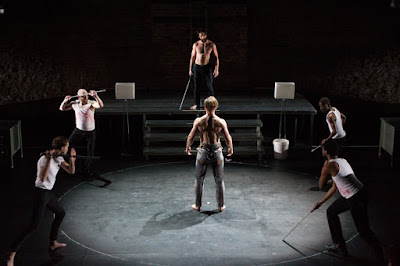
Coriolanus (Torsten Johnson) confronts Aufidius (Michael Wieser, on platform).
Photos: Patrick Kennedy 
The focus, again, is on the characters and the action. No time is wasted getting the battle started. Roman general Caius Martius (Torsten Johnson) leads the troops into battle against the Volscians, led by his old rival Aufidius (Michael Wieser). The battle is waged in a bloody, sweaty, athletic sequence that becomes a pas de deux for Coriolanus and Aufidius, executed shirtless by actors who clearly know their way around a gym. (See photos. Really, see these photos. Don't you love Shakespeare?)

Having defeated the Volscians and captured the city of Corioles, Martius is granted the name Coriolanus. Upon his return to Rome, Coriolanus is greeted with great pride by his mother, Volumnia (Michelle O'Neill), and is persuaded by patrician Menenius (Zach Curtis) to stand for election as consul.

Coriolanus is advised by his mother, Volumnia (Michelle O'Neill) 
and politician Menenius (Zach Curtis).
Unfortunately, Coriolanus is a pompous ass who thinks way too highly of himself and refuses to tone down his opinions to placate the people whose votes he needs. Menenius manages to smooth things over, and Coriolanus is elected, only to be brought down by two tribunes (Grant Sorensen and Adam Qualls) who don't think his heroism is enough to make up for his bad attitude to the poor. They have him banished from Rome, which makes Coriolanus angry. He joins forces with his frenemy Aufidius against Rome, which ultimately leads to his downfall.
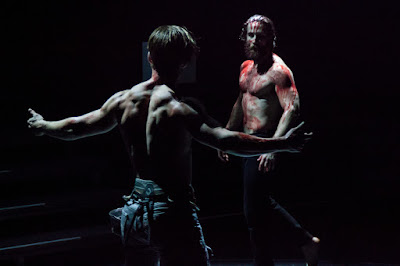
Bringing it on. 
New Epic Theater's production plays up the parallels between Shakespeare's tragedy and modern life. But even while illuminating universal themes, the play doesn't lean into caricature. As stubborn as Coriolanus is about expressing himself, Johnson still shows his character's doubts and makes Shakespeare's words meaningful.

The codependent relationship between the soldier and his mother veers into excessive closeness, but Johnson and O'Neill play their characters so intensely that the extremes of their interactions are a natural extension. Michelle O'Neill is hands down my favorite performer of Shakespeare in the Twin Cities, bringing nuance and texture to Volumnia.

Similarly, it's not surprising when Johnson and Wieser's passionate rivalry dances over the line between love and hate. Curtis is another standout, playing the consummate politician who pleads for compassion in a physically wrenching moment that is painful to watch in the best way. These performances are ably supported by the rest of the eight-member cast playing soldiers, senators, and citizens, always clearly delineated by costume or carriage.

This production is stunning. Seeing a lot of theater, it can be easy for plays to run together in my mind, or to slip away unnoticed. But director Stodola's arresting stage pictures have been running through my mind, both from The Normal Heart and from Coriolanus.

The minimalist set for both shows uses rows of old-style metal desks and a rear platform. The costumes are very similar if not the same: modern and neutral, with shoes—or the lack thereof—holding meaning. Even Dr. Brookner's wheelchair and a hospital gown from the earlier play reappear. The Lab has become a favorite place to see theater, but I'm not sure I've ever felt the scarred, brick walls and scarce offstage space have ever been utilized as successfully as in these two shows. Lucid Thomas's dramatic lighting is almost cinematic in focus, and the sounds created by the cast stomping and thumping on the desks set a martial tone.
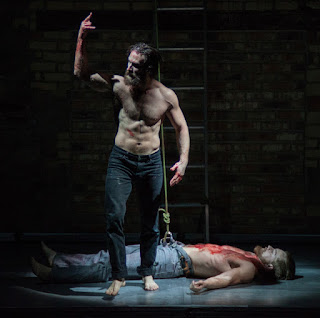
Jeepers.
And it must be said that the actors are the most impressive visual effects. Johnson ably embodies what one of the soldiers says of Coriolanus, "He is their god: he leads them like a thing / Made by some other deity than nature / That shapes man better." And Wieser matches him in physicality and strength, as displayed and emphasized by the expressive movement staged by James Kunz.

The final image in Coriolanus is well worth the price of admission. It's literally breathtaking. When the lights came back on, there was a visceral exhalation of breath from the audience. (And not just the lady behind me who audibly gasped when Coriolanus took his pants off. Come on, lady. Pull yourself together. This is SHAKESPEARE!)

These two plays offer almost an excess of food for thought, with ideas and situations echoing each other as well as current events. The mirror-image relationship of Coriolanus and Aufidius to The Normal Heart's Ned Weeks and Bruce Niles is almost eerie, as are the characters' parallel relationships to Curtis and O'Neill's characters in each play.

Fortunately, New Epic provides a starting point for more study. Excellent background essays by Erica Meium on Coriolanus and The Normal Heart provide concise and valuable context for the plays. And they helpfully reprint the letter that playwright Larry Kramer handed out at the 2011 Broadway revival of his play.

Take advantage of this opportunity to see these two shows in brilliantly conceived and executed repertory. It's not every day that theater like this comes along. New Epic Theater has firmly landed on my can't-miss local theater list.

(co-written by Carly and Jules)

Monday, March 28, 2016

The Normal Heart - New Epic Theater

The young New Epic Theater is living up to its name with their latest endeavor: Two challenging plays in repertory at The Lab Theater (through April 16).

The Normal Heart and Coriolanus are both substantial plays on their own, but to present both with the same director and company of actors is wildly ambitious in the best way. And after seeing The Normal Heart, I can't wait to see what they do with Coriolanus.
Photo by Patrick Kennedy

The Normal Heart is Larry Kramer’s 1985 play about the early days of the AIDS crisis in New York City. The semiautobiographical story follows writer Ned Weeks, who reacts to the deaths of his friends from the mysterious “gay cancer” by becoming an outspoken and frequently abrasive activist and one of the founders of the Gay Men’s Health Crisis organization.

This intimate and intense production features a fabulous cast. Michael Wieser depicts Ned Weeks's journey from writer to outspoken activist with a warmth and humor that lasts even when Weeks's intensity alienates him from his own organization. Torsten Johnson (Bruce Niles) and JuCoby Johnson (Felix, Ned's lover) both provide multi-layered performances in a strong solid cast that also includes Michelle O'Neill, Grant Sorenson, Zach Curtis, Antonio Duke, Adam Qualls, and the always magnetic Grant Sorenson. 

Photo by Patrick Kennedy
The austerity of The Lab Theater provides a perfect backdrop. New Epic’s production, staged by artistic director Joseph Stodola, takes place on a stark stage with neat rows of old-style metal desks facing the back wall, which become waiting areas for the actors who are not actively in the story. Having the actors (mostly) onstage nicely deals with the fact that at the Lab, the entrances to the stage are all at the far corners of the building. It also adds to the gravity of the story, as the actors solemnly watch the proceedings from their desks.

As The Normal Heart is part of two plays in repertory, I feel like I'm writing this with only one half of the story. There are so many elements of the staging of this play and the performances that I think will be more clear after seeing Coriolanus. So we'll be back for more after that!

Further reading:

 If The Normal Heart leaves you wanting to know more about the irascible Larry Kramer, check out this 2015 Boston Globe story: "Even at 80, Larry Kramer Isn't About to Play Nice."

If the play left you with questions about what happened when with the AIDS crisis, check out this fascinating Timeline of HIV/AIDS.

And for an in-depth exploration of the AIDS crisis from the beginning to today, check out Frontline's series on PBS: The Age of AIDS.

(Co-written by Carly and Jules)

Sunday, February 14, 2016

Silence! The Musical - Minneapolis Musical Theater at the Lab

Silence! The Musical (showing now through March 6 at the Lab Theater) is almost definitely the best parody musical based on a horror film that you'll see this year. 

Released in 1991, The Silence of the Lambs won five Oscars and scared the hell out of millions of people. Now that it's an indelible part of pop culture, why not make it a musical? And I can't think of a better local theater than Minneapolis Musical Theatre (and Steven Meerdink's Bitter Boy Productions) to take on this show.

You know the story: FBI fledgling Clarice Starling is sought out to interview famed serial killer Hannibal Lecter in order to find yet another serial killer. Although much of the original movie's script has become go-to pop culture punchlines (liver with fava beans and Chianti, it puts the lotion in the basket, ffffffftttttt) the movie is still genuinely disturbing.

Hannibal Lecter (Tim Kuehl) watches as Clarice
Starling (Emily Jabas) admires his artwork. 
(photos: Unser Imagery) 
So how can this possibly be a hilarious musical? (Which it IS.) Well, it starts off with a fabulously witty book by Hunter Bell, and music and lyrics by Jon & Al Kaplan that manage to be truthful to the source material and tuneful, while hilarious and shocking at the same time.

And then, if you're Minneapolis Musical Theatre, which specialize in musicals rarely seen by Twin Cities audiences (their tagline is "Rare Musicals. Well Done."), you give it 112%. Every member of the cast performs with utter commitment and director Steven Meerdink creates the perfect tone.

The cast hits every joke in the script perfectly, and finds a few laughs that probably aren't in the script, yet never ever milks a joke. The show also has musical theater references that theater fans will love to pick out. You'll note references to Bob Fosse's choreography, Will Rogers Follies, Evita, Cats, and the King and I. These nods add an additional layer of fun to an already hilarious show.
Clarice Starling gets her Fosse on with the chorus of lambs.
Did we not mention the chorus of lambs?
The cast is spot on, referencing the actors' work in the film, but bringing it slightly over the edge in a hysterical way. From the moment that Emily Jabas sprints (slowly) on stage as Clarice Shtarling, you know it's going to be good. Tim Kuehl as Hannibal Lecter gives a delightful blend of menace and confusion, despite acting mostly behind glass and a mask. Alice McGlave gives a great boost to the thankless role of Ardelia (one of film's first black best friends), and Jordan Oxborough was a perfectly insane Dr. Chilton.

My personal favorite performance was by Ryan London Levin as Buffalo Bill. Originally played by Ted Levine in a balls-out, Gene Loves Jezebel-dancing, putting-the-lotion-in-the-basket, Precious-loving performance, Buffalo Bill is one of the most vivid characters in horror. Starting with his first song, "Are You About a Size 14?", Levin gives everything he has to this character and hits it perfectly. He gets Levine's (Levine/Levin/WHAT?) weird mumbly voice perfectly right, and actually has a fantastic singing voice. The entire chorus, including Gregory Adam (so good in MMT's Eating Raoul) and Daniel Lundin (excellent in this season's Murder Ballad) give amazing performances in a variety of roles.

The show is at the Lab Theater, which I hope Minneapolis Musical Theatre can use for future shows. The warm and inviting--but bare bones and industrial--space is perfect for a show like this. The beautifully constructed set by Darren Hensel made perfect use of the space, and the props by Valerie Larche lend a realistic (yet over-the-top) tone to the production.

Starling and Lecter face off  through the high-security window.
By the way, if you are faint of heart and delicate, you may be shocked by some of the material in the show. Hannibal Lecter's first song (of which the Washington Post said the title was too dirty to even hint at) uses a word that is rarely used on the American stage or in film. Hint: It starts with "If I Could Smell Her", and references a line by Multiple Miggs. That's all I'm giving you. But I you pass up this fabulous, hysterical show because of that, well, I would be sad. Go see this fun show!

PS: Every program received a postcard to help promote the show with a 20% off discount code. I don't feel right posting the code, but you could always mention you read about the discount in this review from us and maybe the box office will give it to you. Or check MMT's Facebook page for deals.

(co-written by KRL, Carly and Jules)

Saturday, February 6, 2016

Memory Boy - Project Opera at the Lab Theater

Project Opera is a training program for young singers, from grades 4 - 12. In conjunction with the Minnesota Opera New Works Initiative program, they created a new kids opera - Memory Boy. It has a very limited run at the Lab Theater. Memory Boy is based on the book by Will Weaver, a MN author. The story is about a family escaping from the cities to their cabin up north. There has been a cataclysmic change in the environment and the people, and the safest place is north, away from others. The main character is Miles, and it is his family and his story that we follow through this hour-long, eight scene opera. The opera was composed by Reinaldo Moya with a libretto by Mark Campbell.

This was my first experience with Project Opera and I believe that everyone on stage (from the orchestra to all the singers) where between 4th and 12th grade. If that is the case, WOW!!! We have a lot of talent, young talent, in these Twin Cities. The Lab Theater was set up with audience risers on one side, and the stage on the other. At the back of the stage was a riser with the 13-piece orchestra. The cast was a cast also 13 in number but with a very large chorus. Since there a total of six performances, some of the cast members only sing three of the six. The names listed are who I saw at the first performance (though Kjell does sing at all six). Alex Stokes (playing Miles) was very good with a strong voice, and clear character. In fact the whole family - Sarah, the sister (Emma Shine), Natalie, the mom (Erica Thelen), and Arthur, the father (Kjell Redpath) were great! They sounded very good together and in their respective solos. Also standing out was the character Kurz (Jonathan Rhodes), and the nurse (Tessa Larson). Kurz has quite a bit of singing and he was fantastic! 

Musically it sounded very much like John Adams to me. The music was a bit on the minimal side (not in a repetitive Glass or Reich way), but with a very nice waltz thrown in and a lovely jazz section. The libretto was very good and clearly told a story. There were a few transitions that I felt could be stronger but out of the cheering audience of parents and family, I may have been the only one to think that. Also, there were a few moments where the acting could have been stronger but was par for the course considering the age group and the focus of the program. Honestly, I really enjoyed myself and thought it was a very good piece. I was truly amazed at the talent of these kids and am looking forward to more. Bravo to the Minnesota Opera for having such a wonderful program!