 |
| Cast of Dark Sisters. Photo by Steve Campbell at Loco/FX Photography |

Showing posts with label Opera. Show all posts
Showing posts with label Opera. Show all posts
Friday, September 29, 2023
Opera Alert! Dark Sisters at Journey North
Quick! Opera fans, particularly fans of contemporary opera, get your tickets to Journey North Opera Co.'s production of Nico Muhly's Dark Sisters, It's only playing September 28 through October 1 at the Southern Theater, so this is officially an opera emergency.
We'll make this fast: Dark Sisters premiered in 2011 and provides a fascinating glimpse into the lives of women living in a polygamous compound who are reeling from a raid in which the government has taken away their children after accusations of abuse. More details:

Sunday, March 24, 2019
Candide by Theater Latte Da and VocalEssence
When: March 20-24
At: Cowles Center for Dance and the Performing Arts
Running Time: two and a half hours with intermish
About:
"A tale exploding with star-crossed lovers, melodramatic villains, broad comedy, and a beautiful score, Candide combines the power of opera with the delights of musical theatre. Wrapped in irony, this musical follows the optimistic young Candide in search of “the best of all possible worlds" on an extraordinary journey to reunite with his soulmate. An all-star cast will be joined by a full orchestra and a chorus of sixty--the perfect way to savor the epic beauty of Bernstein's remarkable score."
What We Thought:
Candide includes some of Leonard Bernstein's most memorable music, including the familiar overture, which serves as the theme for PBS's "Live from Lincoln Center."
The book has been revised numerous times since the original 1956 version written by Lillian Hellman. Theater Latte Da and VocalEssence use the Royal National Theatre Version of the play, performed in what the program calls a "theatrical concert version."
At: Cowles Center for Dance and the Performing Arts
Running Time: two and a half hours with intermish
"A tale exploding with star-crossed lovers, melodramatic villains, broad comedy, and a beautiful score, Candide combines the power of opera with the delights of musical theatre. Wrapped in irony, this musical follows the optimistic young Candide in search of “the best of all possible worlds" on an extraordinary journey to reunite with his soulmate. An all-star cast will be joined by a full orchestra and a chorus of sixty--the perfect way to savor the epic beauty of Bernstein's remarkable score."
 |
| Phinehas Bynum, Bradley Greenwald, Philip Brunelle, and Liv Redpath. Photo by Allen Weeks |
The book has been revised numerous times since the original 1956 version written by Lillian Hellman. Theater Latte Da and VocalEssence use the Royal National Theatre Version of the play, performed in what the program calls a "theatrical concert version."
Saturday, March 23, 2019
Cosi fan tutte at Skylark Opera

When: March 22 - 31
At: The Historic Mounds Theater
Running Time: About two hours with intermish
About:
"Skylark Opera Theatre throws a modern new light on the story of two guys who think they can dupe their girlfriends by switching places. But the women have their own power and they aren’t afraid to use it! Mozart’s gorgeous score is sung in English in this immersive production, set in the present day."
What We Thought:
Let's be honest: Opera can feel abstruse to the newcomer. It can be long, dull, melodramatic, and distancing. You have to dress up and applaud at the right times. It's an Important Night Out. Skylark's adorable and hilarious Cosi fan tutte is the polar opposite of that. Set in the present-day in New Rochelle, New York and sung in English, this translation of Lorenzo Da Ponte's 1790 libretto features modern-day references while keeping within the original feel of Mozart's work.
Thursday, July 27, 2017
Maria de Buenos Aires at Mill City Summer Opera
 |
| Maria (Catalina Cuervo) and that DRESS. Photo by Dan Norman. |
This year, due to the repairs at the Mill City Ruins Courtyard, their summer show has moved to a historic industrial spot in Northeast Minneapolis called the Machine Shop. This hip venue turns out to be a perfect setting for Maria de Buenos Aires for this intimate opera-tango-drama, with its urban feel made even more atmospheric by a heavy layer of fog, adding a sultry feel.
With text by Horacio Ferrer and music by Astor Piazzolla, Maria de Buenos Aires premiered in Buenos Aires in 1968. At this production, Mill City Summer Opera artistic director David Lefkowich, in his pre-curtain speech urges the audience to let the music wash over them, try not to work too hard to understand the story. The supertitles are not direct translations of the text, but "help to navigate the surreal poetry and the tango will provide a heartbeat and a mood" (according to the Director's Note.)
 |
| Luis Alejandro Orozco and Catalina Cuervo Photo by Dan Norman |
The work is more of an oratorio than an opera. Written in the key of “Ay! minor” (Ferrer’s libretto is laced with musical puns), it’s a Passion play in which the central character, María, represents both Jesus and the Virgin. She sleepwalks through scenes of sexual violence, her burial and dreamlike confessions to a chorus of psychoanalysts until, resurrected, she gives birth to a new version of herself.So THAT's what happened! The performers are uniformly excellent and inhabit the roles as if they've played them many times before--which they have. The main actor/singers have played these roles multiple times and do so beautifully. The voices of Maria (Catalina Cuervo) and Payador (Luis Alejandro Orozco) are rich and gorgeous, and El Duende (Milton Loayza) narrates the action with the perfect mix of menace and sadness.
Also, noted in the program as one of four main cast members is JP Jofre as the Bandoneon player. Hey, what's a bandoneon, you ask? Here's some info that the very musical among you may understand. All I know is that it creates a beautiful sound and watching Jofre's expressive performance was one of the great pleasures of this show.
 |
| See that guy in white? That's the star of this show, JP Jofre. Photo by Dan Norman. |
Here's the sad news. Theatermaking friends, can I remind you that when you put action on the floor with the audience on risers, sightlines can be challenging. Although we could see most of the action beautifully, as soon as the performers dipped to a certain level, the audience was leaning and straining to see the action. We missed the last scene with Maria entirely and couldn't see the beautiful sparkly dress she was wearing, much less what she was doing.
But in total, Maria de Buenos Aires was atmospheric, delightfully site-specific, with amazing performers and gorgeous music. As usual, Mill City Summer Opera is creating unique, engaging theater and is an utter delight. Also as usual, this is a short and sold out run, so put Mill City Summer Opera on your list for next summer!
Sunday, June 18, 2017
Don Giovanni - Skylark Opera Theatre at The Woman's Club of Minneapolis
Dear Skylark Opera,
In regards to your recent production of Don Giovanni, presented in partnership with Angels & Demons Entertainment and performed at the The Woman's Club of Minneapolis:

Also:

In regards to your recent production of Don Giovanni, presented in partnership with Angels & Demons Entertainment and performed at the The Woman's Club of Minneapolis:

Also:

I could not be more pleased that one of my all-time favorite companies is back and better than ever.
I've loved Skylark Opera since they were NorthStar Opera, and their summer productions have always been a highlight of my theater summer. As a lover of opera and musical theater, operetta hits my sweet spot beautifully, and Skylark Opera has created some gorgeous productions over the years.
Sadly, most of their productions pre-date this blog, but they live on warmly in my heart: 2014's gorgeous Candide, 2013's The Mikado (in partnership with Mu Performing Arts), 2011's fantastically cast On the Town, and 2009's The Desert Song, which was stunning. I could SO go on, thanks to Skylark Opera's Past Production list. Ooh, Wonderful Town with the Baldwin sisters, and a beautiful She Loves Me. Okay, I'm done.
Things have been a bit challenging for Skylark Opera in past years, and the Star Tribune wrote a great summary of their travails and their resurgence. Understandably, they are moving away from operetta and towards more opera productions, but if Don Giovanni is any indication, they are heading in a marvelous direction.
 |
| Gabriel Preisser as Don Giovanni (veramarinerstudio) |
Mozart's 1787 opera Don Giovanni is based on the legendary character of Don Juan and "brings humor and tragedy" [to] "the essentially grim story of a serial seducer who escapes all retribution except death" (thanks, DK Opera Eyewitness Companion!).
The original libretto was by Lorenzo Da Ponte and my favorite sassy opera book comments that "the great thing about Mozart and Da Ponte's take on the story is that the opera's music and text are somewhat more complicated: the don can be seen as a truly oversexed, amoral hell-raiser, a randy young guy who is merely having a good time, or a boastful creep; he does not consummate any sexual act during the opera--it's all hearsay, flirting, and bluster. Maybe." (Weep, Shudder, Die by Robert Levine).
However, Gabriel Preisser (of Angels & Demons) and Robert Neu (of A&D and Skylark Opera) have written a completely new translation, which fits in beautifully with the 1930s time period and the gorgeous setting of Woman's Club of Minneapolis.
 |
| Andrew Wilkowske (veramarinderstudio) |
The opera starts in the lounge of the Woman's Club, with staff passing hors d'oeuvre, and a conveniently located bar. Don Giovanni himself (Preisser) is already wandering about, looking appropriately louche.
Want to know the whole story of Don Giovanni? I recommend checking out the Met Opera's synopsis. (And NOT on your phone during the show while you're in the front row, bald man with glasses with woman with dark topknot and white sweater. People, man.)
Here's your TL; DR of Don Giovanni.
Act One: Donny G--playah extreme--'seduces' Donna Anna. Her dad, the Commendatore, challenges Don to a duel, which Don wins. Anna demands her fiance avenge her dad's murder, then Don's ex Elvira shows up, pregnant. Meanwhile, Don's bestie Leporello fills us in on all the haps. Then a wedding! Don is all over Zerlina (the bride) and gets rid of Masetto (the groom) temporarily. Elvira shows up and is all, 'Girl, don't even,' with Zerlina. Anna figures out that Don killed her dad, there's a party and masks and a gun.
Act Two: Don and Leporello disguise themselves as one another and seduction, singing and confusion ensues. Then we're at a cemetery and the Commendatore's statue haunts Don. More singing, more confusion, and then the statue appears. Bad news for Donny G as he refuses to repent and is consigned to hell. And we're out.
 |
| Andrew Wilkowske and Tess Altiveros. Leporello/Donna Elvira fanfic anyone? (veramarinerstudio) |
The performers are all amazing, and the voices are universally exquisite. Although it can be occasionally challenging to make out the words, to hear these beautiful voices in such an intimate setting is truly a gift. There is NOTHING like intimate opera.
Gabriel Preisser is a marvelously smooth and semi-sleazy Don Giovanni. Andrew Wilkowske, who I tend to adore in everything, is a delightfully humorous and touching Leporello. And he plays guitar in a lovely scene with Tess Altiveros, who is a perfectly gorgeous Donna Elvira. Altiveros handles the role of the wronged woman with wit, strength and considerable charm. Benjamin Sieverding as Masetto and the Commendatore has not only impressive hair, but is genuinely chilling in the last scene as the Commendatore. Quinn Shadko, Karin Wolverton and David Blalock also provide wonderful performances, as does the six member ensemble. And can I just say: Preisser's Wilkowske impression is ON POINT.
So this is all to say, even if the opera had been performed in a traditional setting, it would have been beautifully done. But it's being performed at The Woman's Club, which was built in 1928 and has history seeping from every cornice and corner. The opera ranges through several floors of the building, from the lounge to the ballroom to the dining room and into the theater. Your ticket price comes with the aforementioned hors d'oeuvre, as well as some intermission nibbles, and a lovely after-opera dessert. Plus, the opportunity to wander about in the beautiful Woman's Club building.
I would urge you to go see this, but I'm pretty sure the remaining performances are all sold out. Which bodes well for the future of Skylark Opera. Yay!!
Thursday, November 17, 2016
Das Rheingold at Minnesota Opera

From the very first notes of Wagner's beautiful overture coming from the super-sized orchestra on stage of the Ordway in Minnesota Opera's production of Das Rheingold, I was IN.
The musicians had to be on stage, since they number about twenty more than can fit into the Ordway's orchestra pit. Director Brian Staufenbiel turns this necessity into a strong production design that fits the material perfectly. Hearing Wagner performed live is an experience not to be missed.
 |
| Alberich (Nathan Berg) and the Rhinemaidens Gorgeous production photos by Cory Weaver. |
In the underworld, where the Niebelungen live, the gold gives Alberich the power to control others, including his brother Mime, sung by Dennis Petersen, who is very watchable, resembling Andy Serkis in his almost insectlike costume, herding an adorable bunch of supernumeraries as the other dwarves.
 When the story moves above ground to visit the gods in Valhalla, they appear on a high catwalk above the orchestra, placing them physically and vocally above the rest of the cast.
And the cast is outstanding. Greer Grimsby is solid and in charge, and perfectly embodies Wotan, ruler of the gods. His relationship with Katherine Goeldner's Fricka feels affectionate and intimate. Richard Cox as the demigod Loge is a solid presence in his antler-like headgear, even as we doubt his intentions. Late in the opera, the magnificent Denyce Graves emerges as Erda, Goddess of the Earth. She wears a wonderful nature-inspired costume, and I was tempted to start entrance applause for her. I only wished the role were bigger and that we could have heard more of her glorious voice.
 |
| Denyce Graves as Erda |
The opera is performed as written, without an intermission, and runs two hours and 33 minutes. Surprisingly, I only saw one person leave their seat during the opera, and I'm pretty sure they were having a coughing fit. The opera's program includes a succinct synopsis and a handy family tree that traces the complicated relationships that proceed through the entire Ring cycle, of which Das Rheingold is only the first of four operas.
If this production is deemed a success, we may be fortunate enough to see the rest of the cycle in Minnesota Opera's coming seasons, and I truly hope that happens. Personally, I love Wagner's operas because of the complex mythology and the fact that things happen, unlike many operas where people just sing incessantly about love. [Editor's note: Some of us like people singing incessantly about love. ;)]
 |
| Gods and giants and dragons, oh, my! |
And if you want to know even more about The Ring Cycle, check out the fab documentary Wagner's Ring, about the Metropolitan Opera's recent staging of the entire cycle. It's a fabulous look at a massive production and all of the backstage drama therein.
Monday, July 18, 2016
Sweeney Todd at Mill City Summer Opera

Don't get too excited--as usual, tickets sold out almost immediately. Thank goodness for rush tickets.*
Mill City Summer Opera has been in operation for five years, and this is their first musical. We've had a bit of resurgence in local Sweeney Todds in recent years--it was part of last year's Theater Latte Da season starring Sally Wingert and Mark Benninghofen. (This acclaimed production was to return this season, but for some reason, it fell through.)
 |
| Finally, his arm is complete. Catherine Cook and Robert Orth. Photo by Dan Norman. |
One of the darkest musicals ever written, Sweeney Todd: A Musical Thriller is the unsettling tale of a Victorian-era barber who returns home to London after fifteen years of exile to take revenge on the corrupt judge who ruined his life. When revenge eludes him, Sweeney swears vengeance on the entire human race, murdering as many people as he can, while his business associate Mrs. Lovett bakes the bodies into meat pies and sells them to the unsuspecting public.
Fun, am I right? The musical actually fits the setting beautifully, with a marvelously versatile set (by Narelle Sissons) that features a birdcage and oversized scissors. Judge Turpin's oversized chair did remind me of Edith Ann, but worked well for a snuggling Anthony and Joanna.
 |
| The cast of Sweeney Todd. Photo by Dan Norman. |
As with the other Mill City Summer Opera productions I've seen, the orchestra (led by Brian DeMaris) was outstanding. Robert Orth was a sepulchral Sweeney, and had an uncanny physical resemblance to Len Cariou (who originated the role).** Mrs. Lovett was portrayed by Catherine Cook, who nailed both the comic and the more poignant elements of the character. I haven't heard Mrs. Lovett sung as operatically as this before, but it worked very well.
The talented ensemble cast was fun to watch and consists of powerfully strong singers. In particular, the ensemble numbers such as "The Ballad of Sweeney Todd" and "God, That's Good" filled the Ruins space beautifully.
That said, musical theater is a different animal than opera, and Sweeney Todd, in particular, has a lot of information that is conveyed in dialogue and in song. The dialogue got a bit lost at times in the large space. Also, though the cast and the ensemble was wonderful, I was disappointed to see only one actor of color among the cast of over 30, and in a very minor role--especially given the rich talent in our racially diverse musical theater community.
That said, musical theater is a different animal than opera, and Sweeney Todd, in particular, has a lot of information that is conveyed in dialogue and in song. The dialogue got a bit lost at times in the large space. Also, though the cast and the ensemble was wonderful, I was disappointed to see only one actor of color among the cast of over 30, and in a very minor role--especially given the rich talent in our racially diverse musical theater community.
So why did they choose to take on Sweeney Todd? According to the Director's Note by David Lefkowich: "It was time to push the boundaries of opera and present thrilling music as well as a fantastic story." Hurrah for boundary pushing! I'd love to see them take on some of the marvelous operettas, especially since Skylark Opera has cancelled their Summer Festival (boo hoo).
Just imagine: Sitting in the ruins on a gorgeous summer night and listening to an amazingly talented cast like this singing "Make Your Garden Grow" from Candide or "Ain't It Awful, The Heat" from Street Scene, or Barbe-Bleu by Offenbach, or anything at all by Strauss.
Mill City Summer Opera provides one of the most unique and special experiences in local theater. Fabulous music in a gorgeous setting makes for a not-to-be-missed experience for theatergoers.
*Rush ticket policy: Show up before 7:30 PM, get in the rush ticket line and make all your dreams come true! $35 per ticket. First come, first serve basis. Rush tickets are available on the following show dates: July 17, 19, 21, 22, 24.
**Andrew Wilkowske is a cover for Sweeney Todd. Having seen him mostly be charming and comic in shows such as Minnesota Opera's The Magic Flute, I would LOVE to see what he does with the role.
***Belated trigger warning. There is flagellation. I repeat, there is flagellation.
Tuesday, May 10, 2016
The Shining - World Premiere at Minnesota Opera

The Shining is a world premiere commissioned by Minnesota Opera as part of its New Works Initiative. Composer Paul Moravec is a newcomer to Minnesota Opera, while librettist Mark Campbell’s previous works include the world premieres of Silent Night and The Manchurian Candidate (both also commissioned by the Opera). The collaborators went back to Stephen King’s original 1977 novel, and not the well-known Stanley Kubrick film, which King was never happy with.
If you have somehow missed the book, the Kubrick film, or King's 1997 miniseries, The Shining is a novel about Jack Torrance, who gets a job as caretaker for the Overlook Hotel in Colorado over one winter. He brings his wife Wendy and their son, Danny, and plans to work on a play he is writing. He's hoping the isolated hotel will help him with his work, and to make a fresh start with his family, after his alcoholism and temper have cost him a teaching job. But the Overlook has other plans for Jack.
 |
| Brian Mulligan and Kelly Kaduce (photo by Ken Howard) |
The line between musical theater and opera can be a little close, and some work is better suited to another genre. But The Shining is absolutely perfect as an opera. The music and libretto, natural and realistic in the beginning of the opera, perfectly encapsulates the increasing tension and heightened emotion of the story. The fantastic stage and production designs supports the music and cast at every point.
Minnesota Opera has put a ton of resources into this production, and it all shows on stage. Masterful projection design sets the scene, showing us the vast uninhabited expanses that surround the hotel, helping us to feel the isolation that soon envelops the Torrance family.
Layers of animation and projection combine with practical sets to blur the lines between the realism of the opening and the encroaching sinister forces as the hotel and its madness become all too real. 59 Productions, who designed the animations and projections, recently won a Tony for An American in Paris, and has contributed to a number of Broadway and Metropolitan Opera productions.
The cast was perfect. As the increasingly tortured Jack, Brian Mulligan used his beautiful baritone voice in ways both lovely and ugly, devolving at times into speaking and shouting, conveying the character’s state of mind. Minnesota Opera favorite Kelly Kaduce as Wendy was glorious as always, showing the intense love and commitment of her character as well as her growing fear.
As Danny, young Alejandro Vega was very good in the difficult role of this gifted child who experiences much more than the adults around him. His energy and focus were impressive, and made Danny feel like an actual child in spite of his gifts, which included channeling the voices of the hotel’s ghosts, with the chorus chiming in eerily.
Aside from the Torrance family, the strongest (human) presence in the opera comes from Arthur Woodley as Dick Hallorann, cook at the Overlook. Hallorann is heading to Florida, but he recognizes that Danny has the shining (visions, or precognition) as does Hallorann. Woodley has a great deep voice with incredible ringing high notes. He was so in tune and in touch with the character’s protectiveness of Danny. He was a joy to hear and to watch on stage.
Also of note is a male quartet comprised of Mark Walters, Alex Ritchie, John Robert Lindsey, and David Walton, who sang at a pivotal point in the second act. They were truly sinister and sounded so good together, especially when Brian Mulligan joined them in song. The chorus, and other featured singers were all fantastic.
In addition to the fantastic singing, the performers acted the play beautifully. The connections of the family felt very real, which made it all the more disturbing when things really start to go wrong. The violence necessary to the story was more realistic than most drama seen on opera stages.
Every bit as important as characters are the ghosts of the Overlook Hotel, and the hotel itself. Skillfully contrasted with the realistic, everyday relationships and activities of the Torrance family are the ghosts. They are first seen only as silhouettes, but as Jack’s mania grows, so do the depictions of the hotel’s creepy previous inhabitants, until Jack is moving freely among them.
Modern opera can be a challenge: how can a modern composer create something on par with operas that have existed and been loved for hundreds of years? The Shining is a truly modern opera that features some lovely melodies, but is also truly unsettling. The music creates a tense musical atmosphere that was never overbearing but also never let up. Occasionally tough and sometimes discordant, the music is wonderfully performed to provide the creepy atmosphere that kept the tension mounting.
 |
| Production photo by Ken Howard |
Layers of animation and projection combine with practical sets to blur the lines between the realism of the opening and the encroaching sinister forces as the hotel and its madness become all too real. 59 Productions, who designed the animations and projections, recently won a Tony for An American in Paris, and has contributed to a number of Broadway and Metropolitan Opera productions.
 |
| Brian Mulligan, Kelly Kaduce and Alejandro Vega (photo by Ken Howard) |
As Danny, young Alejandro Vega was very good in the difficult role of this gifted child who experiences much more than the adults around him. His energy and focus were impressive, and made Danny feel like an actual child in spite of his gifts, which included channeling the voices of the hotel’s ghosts, with the chorus chiming in eerily.
 |
| Alejandro Vega and Arthur Woodley (photo by Ken Howard) |
Aside from the Torrance family, the strongest (human) presence in the opera comes from Arthur Woodley as Dick Hallorann, cook at the Overlook. Hallorann is heading to Florida, but he recognizes that Danny has the shining (visions, or precognition) as does Hallorann. Woodley has a great deep voice with incredible ringing high notes. He was so in tune and in touch with the character’s protectiveness of Danny. He was a joy to hear and to watch on stage.
Also of note is a male quartet comprised of Mark Walters, Alex Ritchie, John Robert Lindsey, and David Walton, who sang at a pivotal point in the second act. They were truly sinister and sounded so good together, especially when Brian Mulligan joined them in song. The chorus, and other featured singers were all fantastic.
 |
| Look at that gorgeous production design! (photo by Ken Howard) |
Every bit as important as characters are the ghosts of the Overlook Hotel, and the hotel itself. Skillfully contrasted with the realistic, everyday relationships and activities of the Torrance family are the ghosts. They are first seen only as silhouettes, but as Jack’s mania grows, so do the depictions of the hotel’s creepy previous inhabitants, until Jack is moving freely among them.
 |
| Creepier and creepier. (photo by Ken Howard) |
 |
| Costume rendering by Karin Kopischke |
 |
| Costume rendering by Karin Kopischke |
The costumes, by costume designer Karin Kopischke, add to the stark contrast between the reality of the Torrance family and the surreality of the Overlook's other residents. Each costume is beautifully appropriate to each character, from the everyday 1970s wear of the Torrances to the uniforms of the previous caretakers and staff to the outlandish and unsettling costumes of the masked partygoers.
Honestly, the whole production was superb. Every element worked together perfectly to create a truly sinister and unsettling atmosphere while telling a great story of love and sacrifice that remains true to Stephen King's wonderful book. The Shining is a perfect evening at the opera. Hurrah to Minnesota Opera for commissioning this work; I hope this marvelous addition to the canon has a long, successful life.
(co-written by KRL, Jules and Carly)
Sunday, March 6, 2016
Aging Magician - Walker Art Center - World Premiere/Walker Commission


This work is the story of Harold, an older clockmaker who is also writing a book called The Aging Magician. Through out the piece he speaks of his own life, yet also tells the story of the aging magician who has found a boy to share all his stage magic/secrets with. Rinde Eckert plays Harold and has a great character in that role. Somewhat stuttering, a bit shy, focused on the story and wanting to tell it so badly and to finish writing the story - and at the same time breaking into these beautiful songs that get to the core of both characters - Harold and the magician. Rinde has a fantastic voice that is burnished and warm, yet also with an amazing falsetto and range. Harold talks about clocks and how we in the digital age are so far removed from the classic clocks with their gears moving, rotating, reminding us of the cycles of life and the orbits in the sky. He speaks of different magic tricks and uses some to show us the skills of the aging magician, as well as using them to illustrate the story, to make a point, to get us to think.
 One story he uses is of William Robinson, a magician who performed under the name Chung Ling Soo. According to Harold, he performed under this name so that he didn't have to speak to the audience. He could be silent and just do his magic. Williams/Chung's greatest trick was to catch a bullet in his teeth. At his last performance something goes awry and he is shot on stage, and dies. Harold shows this by falling to the ground, reaching into his inside jacket pocket, getting a deck of cards and then letting them fall out of his hand. A simple action which was so beautiful to watch.
 The set is simple. A set of risers on which the Brooklyn Youth Chorus sits and stands, a string quartet in front, and a desk with a chair at the center stage. There is a bike off to the side, and the back of the risers have a curtain covered with pieces of paper. When we come into the space, Harold is sitting and writing at his desk. Consistently though out the show paper is used in so many different ways - from being held up by the chorus so that video of the Coney Island Cyclone can be shown, to becoming birds in various forms. The top of the desk is also a chalkboard and gets utilized at one point. There are so many things that happen through out the show that were gorgeous and interesting and moving - but it is one of those works that you need to experience. You need to hear the music of Paola Prestini performed by the chorus and the American Contemporary Music Ensemble. The music was beautiful and not in a jagged way that some think of contemporary music, nor in a minimalist way. It was perfect for this work. You need to hear the voices of the chorus mixing with Rinde's voice. You need to see the visuals, especially the ending visual so fantastically created by Mark Stewart. Like so much that I have seen at the Walker, it is a theatrical work that I will be thinking about a lot.
Aging Magician Trailer from VisionIntoArt Presents on Vimeo.
Saturday, February 6, 2016
Memory Boy - Project Opera at the Lab Theater
Project Opera is a training program for young singers, from grades 4 - 12. In conjunction with the Minnesota Opera New Works Initiative program, they created a new kids opera - Memory Boy. It has a very limited run at the Lab Theater. Memory Boy is based on the book by Will Weaver, a MN author. The story is about a family escaping from the cities to their cabin up north. There has been a cataclysmic change in the environment and the people, and the safest place is north, away from others. The main character is Miles, and it is his family and his story that we follow through this hour-long, eight scene opera. The opera was composed by Reinaldo Moya with a libretto by Mark Campbell.
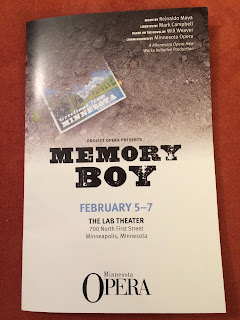

This was my first experience with Project Opera and I believe that everyone on stage (from the orchestra to all the singers) where between 4th and 12th grade. If that is the case, WOW!!! We have a lot of talent, young talent, in these Twin Cities. The Lab Theater was set up with audience risers on one side, and the stage on the other. At the back of the stage was a riser with the 13-piece orchestra. The cast was a cast also 13 in number but with a very large chorus. Since there a total of six performances, some of the cast members only sing three of the six. The names listed are who I saw at the first performance (though Kjell does sing at all six). Alex Stokes (playing Miles) was very good with a strong voice, and clear character. In fact the whole family - Sarah, the sister (Emma Shine), Natalie, the mom (Erica Thelen), and Arthur, the father (Kjell Redpath) were great! They sounded very good together and in their respective solos. Also standing out was the character Kurz (Jonathan Rhodes), and the nurse (Tessa Larson). Kurz has quite a bit of singing and he was fantastic!
Musically it sounded very much like John Adams to me. The music was a bit on the minimal side (not in a repetitive Glass or Reich way), but with a very nice waltz thrown in and a lovely jazz section. The libretto was very good and clearly told a story. There were a few transitions that I felt could be stronger but out of the cheering audience of parents and family, I may have been the only one to think that. Also, there were a few moments where the acting could have been stronger but was par for the course considering the age group and the focus of the program. Honestly, I really enjoyed myself and thought it was a very good piece. I was truly amazed at the talent of these kids and am looking forward to more. Bravo to the Minnesota Opera for having such a wonderful program!
Monday, January 25, 2016
Rusalka - Minnesota Opera
Simply gorgeous.
That may be all you need to know about this production of Dvorák's opera Rusalka. This was one of Dvorák's last operas and the story is certainly familiar. Rusalka is a water-nymph who falls in love with a human Prince. She desires to be with him and so she goes to a witch to become human. The side-effect of this change is that she has no voice. Sound familiar?
The opera is told in three acts - each about an hour long, yet they never felt long. The curtain rises to a raked stage with stone features and a bridge across a crack in the center. The back and sides of the stage have a projection on them, along with some netting coming down from the fly-space. The whole feel is of being underwater, and we see Rusalka (Kelly Kaduce) fall in love. Soon after the projections change to reflect a forest and we see some dryads are playing and dancing, while also flirting with the water-gnome - Rusalka's father (Ben Wager). Rusalka enters, speaks of her love, sings to the moon and heads off to change her life. That is the essence of Act One but oh, the music and singing!!
Act Two starts off in a way I had never thought of. It is made very clear that though the Prince and Rusalka have only been with each other for a week, they are still intimate and passionate - though the Prince's passion is fading. The location is the castle and while some of the rock formations have been moved, the rest of the set is very cold and hard - projections in color with no warmth. The costumes are all in black, white, and grey while Rusalka is in a stunning vibrant red. This act shows the decay of the short relationship, Rusalka's growing unhappiness, jealousy, and despair, the Prince's lack of understanding and his movement towards the next best thing - a human Princess. This act is set at a a party to celebrate the engagement of the Prince to Rusalka, so naturally there are guests and dancing. The guests were paired off and dancing together through most of the act. It was fantastic! Each of the women's costumes was unique and gorgeous. More than that though - each dancer clearly had a character and a relationship with their dancing partner. Through the act these relationships clearly started to falter - sometimes with humor as characters were getting drunk, othertimes with anger and face-slapping. These dancers/actors were a joy to watch - Erin Drummond, Betsy Gaasedelen, Kevin Iverson, Lauri Kraft, James Kunz, Jennifer Mack, Tony Vierling, and Joey Weaver.
Act Three - well, I'm sure you have figured out some of the ending by now so I won't go into it. Let me just say that it was just as gorgeous as the first two acts. It has beautiful projections (all by Wendall K. Harrington), gorgeous singing, and a very moving ending. What made this night more memorable is that the man playing the Prince fell ill earlier in the week. So AJ Glueckert stepped in after singing off-stage during the dress rehearsal and learning the blocking the day previous. I love live theatre! The opera may seem like a big show yet the cast was a cast of nine singing roles. They sang their hearts out and provided one of the more generous curtain calls I've seen - calling up not only the conductor but also three other members of the production team. Gorgeous and fantastic production - go see it.
 |
| Photo: Dan Norman |
The opera is told in three acts - each about an hour long, yet they never felt long. The curtain rises to a raked stage with stone features and a bridge across a crack in the center. The back and sides of the stage have a projection on them, along with some netting coming down from the fly-space. The whole feel is of being underwater, and we see Rusalka (Kelly Kaduce) fall in love. Soon after the projections change to reflect a forest and we see some dryads are playing and dancing, while also flirting with the water-gnome - Rusalka's father (Ben Wager). Rusalka enters, speaks of her love, sings to the moon and heads off to change her life. That is the essence of Act One but oh, the music and singing!!
 |
| Photo: Dan Norman |
 |
| Photo: Dan Norman |
Sunday, January 24, 2016
Letter from Chicago - Bel Canto at Lyric Opera of Chicago
 |
| Set image from lyricopera.org |
In the novel, a world-famous soprano is hired to sing at a birthday party for a Japanese industrialist, held in an unnamed South American country. When the party is taken over by terrorists, the partygoers are held hostage in the home of the country's vice president. It's a perfectly gorgeous novel, and one I've read over and over again. As an opera fan, I think so often of this quote:
"All of the orchestra supports her now, it reaches with the voices, lifts the voices up, the beautiful voice of Roxane Coss is singing her Gilda to the young Katsumi Hosokawa. Her voice vibrating the tiny bones deep inside her ear. Her voice stays inside him, becomes him. She is singing her part to him, and to a thousand other people. He is anonymous, equal, loved."
 |
| Photo by Andrew Cioffi |
And hurrah for new opera! Hurrah for opera companies taking a chance and commissioning new work. Hurrah for composer Jimmy Lopez and librettist Nilo Cruz, both of whom bring their rich culture (Peruvian and Cuban-American respectively) to this traditionally white, European art form. And hurrah for an opera with absolutely marvelous racially diverse characters and performers.
 |
Nilo Cruz and Jimmy Lopez,
Sir Andrew Davis and Kevin Newbury.
Photo: Todd Rosenberg
|
And here's the other thing: In the book, the music transcended language. In fact, the primary character emerged to be Gen, the Japanese industrialist's translator. With opera, it can be difficult to distinguish between the languages--especially as they're all subtitled in English. When I heard that Andrew Stenson sang in eight languages, I was astonished. It's hard to really see the singing crossing barriers when a) everyone sings, and b) you can't distinguish languages.
I also feel like there were too many people moving around the stage, and we weren't able to distinguish the characters--the relationships would be hard to determine if you hadn't read the book. And I adore this book, so it's particularly hard to let go of those strong characters. They also took away the unnamed aspect of it and made it more specific to the original incident that inspired the book, which took place in Peru, which took away some of the mystery of the book.
I can actually see Bel Canto more as a play with music. You can still play with language, and bring in the amazing arias, but keeping it less musical would make it more powerful. And I'll say it: I adore this book.
That said, YAY NEW OPERA. I look very much forward to more work by Jimmy Lopez, and more operatic work by Nilo Cruz. And I look forward to seeing what shape this opera takes as other opera companies take it on. I feel extraordinarily lucky to have seen it at the beautiful Lyric Opera House.
Want to know more about this opera? Check out Lyric Opera's handy Online Opera Guide. There's also tons of information on their website including sneak peeks at the music, behind the scenes videos, and book discussion guides.
Sidebar on Lyric Opera of Chicago: This is a fabulous place to see an opera. Gorgeous house and dining room, ample lobby space for mingling and enjoying cocktails, and having seen shows from the second tier and the front row, I can say both are wonderful. And the staff! From box office, to bar, to elevator operator to ushers, they are amazingly friendly and helpful and provide world-class customer service. Also, if you get the chance, take their backstage tour. It's worth it just to see the costume department (oh, those gorgeous Der Rosenkavalier costumes!) up close.
Wednesday, November 18, 2015
Review - The Magic Flute at MN Opera
 |
| from the MN Opera Website |
The Magic Flute by Mozart, currently playing as part of Minnesota Opera's 2015-2016 season, is a charming opera that is about love, revenge, trials and rewards. It is probably best known for the Queen of the Night aria, and possibly the charming duet between Papageno and Papagena. The first time I heard anything from this opera was in the film Amadeus. I also saw a wonderful production at Theatre de la Jeune Leune back in the day.
 |
| from the MN Opera Instagram |
 |
| from the MN Opera Instagram |
I realize this sounds crazy so let me explain. The set is a simple white wall with certain portions that turn around to reveal actors. Everything else is projected on the white background. You can see from this backstage pic how it works. And from an audience view, it works great! It allows for some really great visuals, and some very funny moments. Papageno has a pet cat that keeps showing up, and watching the actor interact with the projection is just charming.
One of the aspects of this production I really enjoyed were the recitatives. This may sound odd except they kept the silent film style so the actors pretended to speak while the projections showed what they had said. All of this was done to a harpsichord (piano?) that sounded like a player piano from a silent film. It was imaginative, never boring and gorgeous to watch.
So, if you have any doubts - go see it and judge for yourself. If you need further evidence, check out this trailer. It is a fantastic production!
Wednesday, June 17, 2015
Romantic Summer Opera - La Rondine at Skylark Opera

I love musical theater, I love opera, and like peanut butter and chocolate, if you put them together, you get perfection in the form of operetta. Almost no one in town is performing operetta right now, so I feel especially grateful for Skylark Opera. Even if they decide to forego the operetta this year for flat-out (albeit light) opera and musical theater.
There is just something about Skylark Opera's summer festival that warms my theatergoing heart, which I couldn't help but ponder as I watched La Rondine and Putting It Together.
The runs are amazingly limited, and seem to always take place on the most beautiful warm summer's night, or afternoon. But I never regret the time I spend in the intimate E.M. Pearson Theater. There's something about the simple sets, the gorgeous lighting (often by local genius Michael Wangen), the exquisite orchestra with musical direction and conducting by Artistic Director Steve Stucki, and the marvelously talented casts. As I watched this summer's shows, I was suffused with warm memories of other amazing Skylark shows I've loved in the past like The Desert Song, Wonderful Town and She Loves Me, as well as too many charming operettas to count.

From the creator of La Bohéme comes the story of Magda, who flees her luxurious life as the mistress of a wealthy banker for the hope of true love. Sung in English, this first-ever Twin Cities production marries operetta’s romance with opera’s deep emotion, and features some of the most sumptuous music Puccini ever wrote.A slight personal digression: The first time I ever remembering hearing opera was in the gorgeous 1986 film A Room with a View, which had two arias sung by Kiri Te Kanawa, which led me into loving opera. Thank you, Merchant-Ivory! I had forgotten that one of the arias was La Rondine's "Chi il Bel Sogno di Doretta," which is so beautifully sung, so beautifully timed, that I will forever associate opera with beauty and kissing Julian Sands in a field of poppies while wearing a gorgeous dress. (The other aria? The also gorgeous "O Mio Babbino Caro.") Relive the magic here:
Skylark's production of La Rondine absolutely lives up to the promise of its gorgeous first aria (as heard above.) Directed by Ben Krywosz, simply staged, beautifully lit, wonderfully acted, and with gorgeous orchestration and singing, this is the perfect opera for a summer's night. Cecilia Violetta Lopez as Magda sang exquisitely--seemingly effortlessly--and acted the role with ease and emotion. Her voice was one of the best I've ever heard on a Minnesota stage, and she'll be on my to-watch list from now on. Won Whi Choi as her suitor Ruggero balanced a youthful aspect (in keeping with the story) and a solid and thrilling baritone. They were a lovely and thrilling romantic pairing. One more standout for me was the engaging Norman Shankle as the poet Prunier. In addition to having a gorgeous voice, Shankle was a marvelous comedian and had a wonderful stage presence. Add to this a lovely chorus with gorgeous voices, and a romantic story, well acted and sung, and it's a lovely opera for your summer's night. Go quick! It only plays through June 21.
(Power tip: For the fascinating backstory on this rarely performed opera, check out Ben Krywosz's Director's Notes in the program.)
Thursday, May 21, 2015
Review: Joyce DiDonato
What an amazing place we live in. Where we can go from seeing a brand new play on a Saturday night in the midst of Art-a-Whirl, to seeing an internationally acclaimed mezzo-soprano on Tuesday. The amazing Joyce DiDonato gave a recital as part of the Schubert Club at the Ordway Center for the Performing Arts. She was, in a word, glorious.
 She opened the first portion of the recital with "Canciones clasicas espanolas" by Fernando Obradors. Seven songs in Spanish that showed her range, not only vocally but in character. Each song was not sung, but performed. With the amazing David Zobel on piano, each song had a story to tell, a character to show. I had never heard of this composer and was really charmed by this selection of songs. Obradors had written four volumes of "Classical Spanish Songs", and this was the first volume. It was a perfect opening to warm up the audience to what they could expect for the remainder of the recital. Following that, she went back to an earlier composer, and one which she is probably better known for - Rossini. She sang the "Willow Song" from Otello and it was beautiful and moving.
She ended the first half of the recital with a Beaumarchais Trilogy - three songs from two operas based on the plays of French writer Beaumarchais. The first two were from Le Nozze di Figaro by Mozart, and the final from Il barbiere di Siviglia by Rossini. The first aria was "Voi che sapete" from The Marriage of Figaro. This was sung by Cherubino which is a pants role (woman playing a man), and Ms. DiDonato clearly had fun singing it. Following this was a beautiful and charming aria "Deh vieni, non tardar" also from the same opera. She ended the trilogy with "Una voce poco fa" from The Barber of Seville. While this is a very well known aria and performed often, I had mainly only heard the recordings of Callas. It was a true joy to hear a different take on the aria.
I'm going to pause here because here is the thing about recitals. The music is wonderful and the performance is brilliant. But what about the visuals? For those of us who love theatre and opera, sometimes the visuals can be missed in a recital. The main stage of the Ordway was turned into a perfect recital hall with dark brown back walls. A single piano in the center, and a wonderful singer. You can't ask for much more. Yet, I feel like I need to write some about what DiDonato was wearing. The first half of the recital she was in a beautiful pale green gown (see below). It was strapless with a gather at the left front side giving some movement to the gown. She had a gorgeous v-shaped necklace as well. For the second half, she came on in a stunning multi-color dress. The dress was form-fitting, full length, and had long sleeves. Trust me, it was much more fun to watch than a simple tuxedo on any male performer.
 Speaking of the second half, she started it with two arias from Cleopatra. The first was from Marc'Antonio e Cleopatra by Hasse, while the second was from Giulio Cesare by Handel. Listening to her fluid runs and trills during these two pieces, this is a style of music almost written for her voice. She showed so much control yet wasn't holding back either. They were and are fantastic showcases for the magic that is her voice, and the training and experience she has had. The recital closed with another song-cycle, "Venezia". This one was by Reynaldo Hahn, and is originally seven songs about Venice. She performed six of the seven. She stated before starting that this set of songs really opened her up to the power of music when she first discovered them. She was enthralled with how evocative the lyrics and the music were. I can attest that it is true. It is a gorgeous song-cycle that I will be listening to more.
And that was the program. Of course, after the last note started to fade, the first of many standing ovations began. The first of many you say? How can that be? Well...when there are three encores, the audience is given plenty of time to applaud and show their love and appreciation. The first encore was from La Donna del lago by Rossini. I am not sure of the specific aria, but it was beautiful. Another standing ovation and she came back on to seeing a Neapolitan Art Song called "Don't Forget Me." She stated that she felt a bit selfish saying the title, which gives you an idea of her charm and sense of humor (she did name a cd "Drama Queens" after all). Again, this was a very moving and beautiful piece.
Her final encore may have been a tribute to Minnesota. She spoke earlier before the second encore of her travels here before starting college. She stated that she was looking at St. Catherines and wondered a bit about the possibilities. When she came back on for the last encore, it was a simple song, a familiar song, and the perfect song to end the evening - "Over the Rainbow" by Harold Arlen. To make it more perfect, David Zobel added a few notes from "Una voce poco fa" at the very end.
If you have a chance to see Joyce DiDonato perform, please take that chance. Either live on tour, or in some of the numerous "Live in HD from the Met Opera." You will not be disappointed. If you want to hear some samples of these pieces, you can find them on I-tunes, or Classical Archive.
Subscribe to:
Posts (Atom)